New AI Models Reward Systems: Claude Opus and Dynamic Workflows
Why new AI models like Opus 4.8 reward systems over prompts: Dynamic Workflows in Claude Code and managed, verified work.
· By Guilherme Salgueiro
The important part of Opus 4.8 is not that Claude got smarter.
It clearly did. Anthropic's launch post says the obvious part out loud: better coding, better agentic work, stronger professional reasoning, and more reliable long-running execution. I felt the same thing using it. Opus 4.8 catches things 4.7 would sometimes miss, is more honest about uncertainty, and is more willing to push the work forward instead of waiting politely for the next instruction.
But the more interesting question is not whether the model improved. The question is what improves when the model improves.
If your AI setup is just a chat window, a model upgrade gives you better answers. If your context window is already leveraged by CLAUDE.md, agents, skills, hooks, workflows, and review loops, the same upgrade improves the whole operating system around the model.
The files do not change. The workflows do not change. The system you already built simply starts producing better work.
That is the real lesson of Opus 4.8 and Dynamic Workflows.
The model race is shifting from "who gives the best answer?" to "who can reliably finish the work?" We are moving into an outcome-focused AI provider race, where Anthropic, OpenAI, Google, and everyone else are competing less on isolated answers and more on finished, verified work. And we are all better for it.
What a time to be alive.
- The useful question is not whether Opus 4.8 is smarter. It is what improves when the model improves.
- Dynamic Workflows move Claude Code closer to managed work: many subagents, verification loops, progress persistence, and one coordinated return surface.
- Better models reward better systems.
CLAUDE.md, skills, hooks, agents, tests, acceptance criteria, and review gates are the surface area a new model can upgrade. - The risk is faster incoherence. Broad workflows need tight rules around scope, budget, evidence, and verification.
What Dynamic Workflows Actually Are
Dynamic Workflows are the more important announcement because they change the unit of work.
A normal AI session is still mostly conversational. You ask, it answers. You ask again, it revises. Even when tools are involved, the shape is familiar: one thread, one assistant, one evolving context window.
Dynamic Workflows move Claude Code closer to a project runner.
Anthropic describes the feature as Claude dynamically writing orchestration scripts, running tens to hundreds of parallel subagents in a single session, checking the work before it reaches you, and preserving progress across interruptions. It is still a research preview, which is the right label. This is powerful, expensive, and slightly wild. But the direction is obvious.
When I used it yesterday, the interesting part was not one brilliant agent solving one problem. It was the surface area covered by the system moving in parallel. Multiple agents per phase. Most of them Sonnet. Some reading, some inspecting, some comparing, some synthesizing, some preparing the next move. The output was not a chat response. It was an orchestrated work product built from a much wider scan than I would normally ask one assistant to perform.
This is the practical difference: an agent team gives you a few specialized workers. A Dynamic Workflow gives you a temporary execution system around the work: many agents mapping, checking, refuting, fixing, and converging before the answer reaches you.
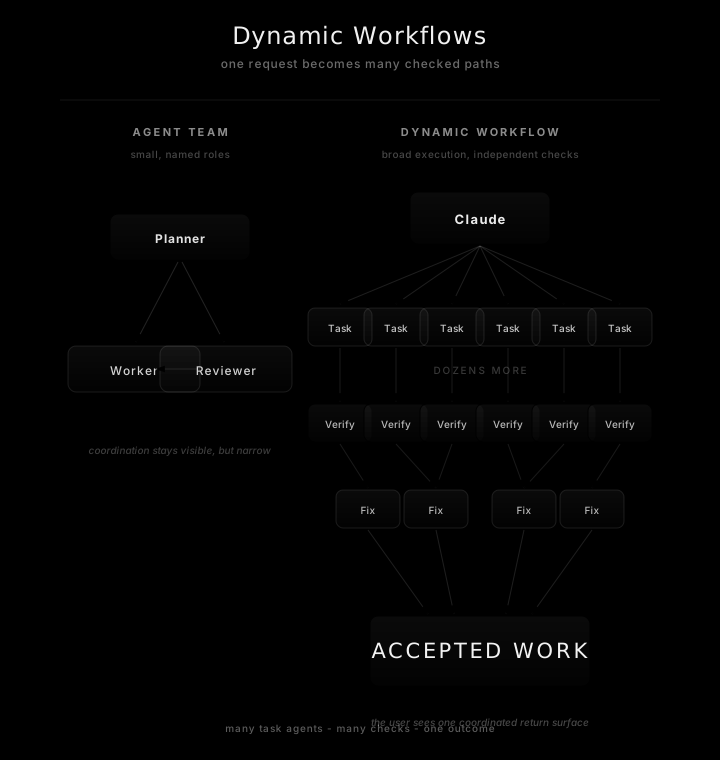
Dynamic Workflows are not a bigger agent team. They are a temporary execution system: many task agents, many verification agents, many fix loops, one return surface.
You can point this at a large codebase audit, a Supabase project with tables and edge functions, a multi-step research sweep, a migration plan, a content system, or a messy folder full of files, and ask it to build enough shared understanding that the next action is no longer blind. It is not just "do the task." It is "map the terrain, divide the work, collect evidence, verify the pieces, reconcile the findings, and come back with something I can act on."
The Bun example shows the extreme version of this. Anthropic says Dynamic Workflows were used in a Zig-to-Rust port that produced roughly 750,000 lines of Rust, reached 99.8% of the existing test suite passing, and moved from first commit to merge in eleven days. That is not normal usage, and it should not become the baseline expectation. But it shows the shape of the thing: parallel decomposition, verification loops, and one coordinated return surface.
The caveat is not small. Anthropic explicitly warns that Dynamic Workflows can consume substantially more tokens than a typical Claude Code session, and my experience matches that. This is not a casual default for every task. It is a tool for breadth: audits, migrations, research, adversarial review, and messy discovery work where a single-pass assistant would miss too much.
The provider race gets more interesting here. Better models matter, but better orchestration changes what a model can be used for. The value is no longer only inside the answer. It is in the managed path to accepted work.
The System Is What Compounds
The practical question is not "how do I use Opus 4.8?"
That question expires too quickly. Today it is Opus 4.8. Tomorrow it might be a new Codex release, Gemini, Mythos, or something none of us has a name for yet. The provider race is moving too fast for model-specific tactics to be the durable layer.
The better question is: what part of my setup gets better when the model gets better?
If you use AI transactionally, the answer is simple. The chat gets sharper. The answer improves. You save a few minutes.
If you have a real system, the upgrade compounds through every layer: your CLAUDE.md, your agents, your skills, your hooks, your review loops, your project instructions, your reusable workflows, your acceptance criteria, your source folders, your test suite, your memory, your permissions. This is the same architecture behind 100x Your AI. Same Model as Everyone Else.: same model, different machine around it.
Same files. Better execution.
That is the part most people miss. A new model does not only improve the next prompt. It improves every reusable pattern you already moved out of your head and into the harness.
This is why the boring setup work matters. The context file. The repo instructions. The custom skill. The workflow checklist. The review gate. The "do not edit yet, map the system first" habit. The Opus 4.8 API docs point in the same direction: better long-context handling, better tool triggering, lower prompt-cache minimums, and better compaction recovery all matter more when you already have reusable work for the model to run through.
None of that looks impressive when you build it. It looks like admin. Then the model improves, and the admin becomes leverage.
The people who benefit most from every model release will not be the people who refresh benchmark charts the fastest. They will be the people with the most prepared surface area for the new model to run through.
Better models reward better systems.
Where Dynamic Workflows Actually Make Sense
Dynamic Workflows are not for everything.
That is the first discipline. Just because Claude can spawn a small civilization of agents does not mean every task deserves one. If you need to rename a component, fix a typo, draft a short email, or answer a narrow question, a normal session is cleaner. The overhead is not worth it.
Dynamic Workflows make sense when breadth is the bottleneck.
The obvious use case is a large codebase audit. Not "look at this file," but "scan the repo for dead code, unsafe auth patterns, inconsistent error handling, duplicate logic, fragile edge functions, stale migrations, broken tests, or places where the documentation no longer matches the implementation." A single agent can do some of that. A workflow can fan out across the terrain.
The same applies to Supabase-heavy systems. Tables, RLS policies, edge functions, database types, API surfaces, and frontend usage often drift apart quietly. One agent reading one path will miss the shape. Dozens of agents can inspect different slices, compare findings, and surface the inconsistencies a human reviewer would not have time to chase manually.
Research is another obvious fit.
Not "summarize this article," but "map the current state of this market, extract the strongest primary sources, compare the claims, identify contradictions, and come back with the questions I should ask next." Dynamic Workflows are useful when you want a wider first pass before judgment. They are not a replacement for judgment.
Migrations are the more aggressive version. Framework upgrades, API deprecations, language ports, design-system migrations, content-library cleanup, documentation rewrites. Anything where the work is broad, repetitive, partially independent, and still needs verification.
That last phrase matters: still needs verification.
The best Dynamic Workflow tasks have three properties:
- The work can be divided.
- The outputs can be checked.
- The final result has a clear acceptance surface.
If the work cannot be divided, parallelism adds noise. If the outputs cannot be checked, parallelism adds confidence theater. If the final result has no acceptance surface, the workflow can return something impressive that nobody should trust.
This is the move: do not ask for magic. Ask for inspectable work.
Scope the terrain. Define what counts as a finding. Ask for evidence. Require independent verification. Set the budget. Decide what should be changed now, what should be reported, and what should stay untouched.
Dynamic Workflows are powerful because they move fast across a wide surface area. That is also why they need tight rules around them.
The Temporal Pincer Problem
Dynamic Workflows are closer to Tenet than Iron Man.
Not because AI is time travel. Please, no. Because the useful idea in Tenet is the temporal pincer movement: two teams moving through the same operation from different directions, using different information, so the whole mission can be understood from more than one angle before it converges.
That is the interesting part of Dynamic Workflows.
A normal agent run is linear. It moves forward through the problem and hopes the path it chose was the right one. A workflow can attack the same terrain from multiple directions: one set of agents maps the codebase, another checks the assumptions, another looks for contradictions, another tries to break the conclusion, another prepares the fix path.
The point is not "more agents."
The point is independent angles of attack.
That matters because broad AI work fails in predictable ways. One agent can anchor too early, miss a hidden dependency, trust a stale file, overfit to the first plausible explanation, or produce a report that sounds coherent because it never had to survive opposition.
Dynamic Workflows are interesting when they create opposition inside the process. Not just implementers. Verifiers. Refuters. Fixers. Review loops. Separate passes that make the final answer less dependent on one agent's first interpretation of reality.
This is also why your judgment still matters. In Tenet, the pincer only works because the mission has structure. The teams know the target, the timing, the constraints, and the handoff points. Without that, you do not get coordination. You get expensive confusion moving in multiple directions.
Same here. Dynamic Workflows need tight rules around them: scope, budget, sources, acceptance criteria, no-edit boundaries, verification requirements, and a clear return surface. Otherwise dozens of agents do not create intelligence. They create narrative density.
The win is not autonomy for its own sake. The win is coordinated work that arrives more checked than a single pass could have made it.
The Cost of Moving This Fast
The uncomfortable part is that all of this burns tokens fast.
Not "a little more than usual." Fast.
That is not a bug in the idea. It is the price of the shape. When you ask a system to spin up many agents, inspect a large surface area, verify findings, reconcile outputs, and keep enough state to return something coherent, you are no longer paying for one answer. You are paying for a temporary organization.
That is the right way to think about the cost.
A normal chat is a conversation. A Dynamic Workflow is a project team. The bill should not be compared to one prompt. It should be compared to the cost of the work it replaces, accelerates, or makes possible.
For a small task, that comparison fails immediately. If the work would have taken ten minutes, spending a large workflow on it is theater with a meter running.
For the right task, the comparison changes.
A codebase-wide audit, a migration plan, a multi-source research sweep, a Supabase consistency review, a dead-code hunt, a security pass, a content-system cleanup. These are the kinds of things that usually do not happen because nobody has the spare attention to do them properly. They sit in the backlog as "important" work that never beats urgent work.
Dynamic Workflows make that kind of work more reachable, but they do not make it free. So the question becomes: is this worth a temporary organization?
If the answer is yes, spend the tokens deliberately. Scope the run. Define the acceptance surface. Ask for evidence. Decide what should be changed, what should be reported, and what should be left untouched. Use cheaper agents for breadth and stronger models for synthesis and validation.
If the answer is no, stay in a normal session. The future is not "use the biggest workflow for everything." That is just enterprise software behavior wearing a hoodie.
The future is matching the shape of the AI system to the shape of the work.
Build The Surface Area For The Next Upgrade
If you want every model upgrade to matter more, stop putting all the intelligence in the prompt.
Move repeatable judgment into the system around the prompt.
Start with the boring file. Write a real CLAUDE.md or project instruction file. Not a motivational poster. A working contract: what the project is, what good work looks like, what must not be touched, how tests run, where source truth lives, what tone to use, what risks matter, when to ask before editing. If you want the foundation, start with Start with CLAUDE.md and Your First Product Isn't the App.
Then turn repeated work into skills.
If you ask for the same kind of work twice, there is probably a workflow hiding inside it. Code review. Research brief. Customer call prep. Blog draft. Supabase audit. PR cleanup. Meeting summary. Migration plan. Do not keep re-explaining the shape. Write the shape down once, then improve it every time it breaks.
Next, add review gates. A model should not be allowed to define "done" alone. Give it acceptance criteria before it starts. Tell it what evidence you expect back. For code, that means tests, lint, build, typecheck, diff summary, risk summary. For research, that means primary sources, contradictions, open questions, confidence levels. For content, that means thesis, voice, claims, citations, and reader action.
The move is simple:
That one shift changes the relationship.
You are no longer asking the model to be impressive. You are asking it to make work inspectable.
Then separate breadth from judgment.
Use cheaper, faster agents to map the terrain: read files, collect sources, inspect tables, find duplicates, compare APIs, list risks. Use stronger models where the cost of being wrong is higher: synthesis, final recommendations, adversarial review, architectural decisions, legal/compliance-sensitive claims, anything that requires taste.
This is how you avoid paying Opus to open every cupboard and avoid trusting Sonnet to sign the final memo.
Finally, capture what goes wrong. Every annoying correction is a system improvement waiting to be written down. If the model repeatedly over-edits, add a rule. If it forgets your voice, add examples. If it skips tests, add a gate. If it invents citations, add a source policy. If it touches files too early, add a no-edit planning boundary.
The compounding loop is not complicated:
That is how your setup becomes more valuable over time. Not because it is elaborate. Because it remembers.
When the next model arrives, it inherits all of that.
Your context. Your workflows. Your tests. Your rules. Your scars.
That is the surface area the upgrade can use.
The New Race Is Finished Work
The model race used to feel like a leaderboard.
Who scores higher? Who writes better code? Who wins the benchmark screenshot on launch day? Who gets the first thread saying the old champion is dead?
That era is not over, but it is getting less interesting.
The real race is shifting underneath it. Anthropic is not only trying to make Claude smarter. OpenAI is not only trying to make Codex sharper. Google is not only trying to make Gemini more capable. The prize is bigger than the next answer.
The prize is finished work.
Work that can read the context, move through files, inspect evidence, coordinate agents, run checks, recover from interruptions, preserve progress, and come back with something you can accept, reject, or improve.
That is a much better race.
Because if the providers are competing on outcomes, we all get pulled forward. The tools become less about sounding intelligent and more about being useful under pressure. Less theater. More shipped artifacts. Less "here is a suggestion." More "here is the work, here is what changed, here is what passed, here is what still worries me."
That is the world I want.
Not because AI replaces judgment, but because it gives judgment more leverage. It lets you spend less time dragging work into existence and more time deciding what deserves to exist.
This is why Opus 4.8 matters. Not as a shrine. Not as a permanent winner. The winner will change. The leaderboard will change. The provider drama will change by the time you finish your coffee.
The system you build around the model is what remains.
Build that well, and every new model becomes more than a new toy. It becomes an upgrade to work you already know how to delegate, inspect, and accept.
That is the shift.
From answers to outcomes.
From prompts to systems.
From vibe coding to accepted work.
What a time to be alive.
Frequently asked questions
What are Dynamic Workflows in Claude Code?
Dynamic Workflows let Claude Code plan a large task, write orchestration scripts, fan work out across many parallel subagents, check results, iterate, and return one coordinated answer. Anthropic launched them as a research preview for broad, long-running work.
When should I use Dynamic Workflows?
Use them when breadth is the bottleneck: large codebase audits, migrations, Supabase or database consistency reviews, security passes, dead-code hunts, multi-source research sweeps, and other work that can be divided and verified.
How do new AI models compound through an existing setup?
If your setup already has project instructions, skills, hooks, agents, tests, review gates, and acceptance criteria, a stronger model improves every reusable workflow that runs through that system. The prompt is no longer the whole interface; the system around the prompt becomes the multiplier.