Learning by Doing: Why Knowing Is Not Enough
Why learning by doing beats explanation for the lessons that matter. What 2,500 years of thinkers noticed about knowledge versus wisdom.
· By Guilherme Salgueiro
"What's the most resilient parasite? An idea." Cobb was right. In Inception, the entire plot hinges on the premise that once an idea takes root in someone's mind, it is virtually impossible to eradicate. Billions were spent, dreams were layered inside dreams, because a single planted thought could reshape a life.
But Nolan got the drama backwards. The hard part is not planting an idea. The hard part is getting someone to act on one that is already there.
What if the solution to most of your problems was already inside your mind?
Not all of them. But the ones that keep you up — the relationship you already know is not working, the habit you defend with logic you do not believe, the decision you have been postponing because the answer is obvious and uncomfortable — those, you have known about for a while.
We learn new things every day. But the pattern that quietly wrecks most lives is not ignorance. It is the gap between what we already understand and what we actually do — the absence of practical wisdom. There is a category of human insight that cannot be transferred by telling. It can only be — reluctantly, painfully, sometimes repeatedly — lived.
This is not about what you should know. It is about why knowing was never going to be enough — and what you can do about it.
Marianne Williamson wrote that "our deepest fear is not that we are inadequate. Our deepest fear is that we are powerful beyond measure." If you already have the answer and you are still not acting — ask yourself honestly: are you afraid of the darkness, or are you afraid of what your life looks like when you stop making excuses and step into the light?
Unteachable Lessons
In February 2025, Chris Williamson sat down to record his 900th episode of Modern Wisdom — one of the most-listened-to podcasts in the world. No guest. Just a list. The first item on it was a category he called unteachable lessons: a special subset of wisdom that, for some reason, we all refuse to learn through instruction.
His list is disarmingly simple:
Money won't make you happy. You will regret working too much. You should see your parents more. You'll be fine after the breakup. It's perfectly okay to cut toxic people out of your life. All of your fears are a waste of time.
Read those again. You already agree with every single one. And you are almost certainly failing to act on at least three of them right now.
That is the phenomenon. Not ignorance — agreement without action. Williamson's observation is sharper than it looks: "No matter how arduous or costly or effortful it's going to be for us to find out for ourselves, we prefer to disregard the mountains of warnings that we get from our elders, and songs, and literature, and historical catastrophes. And instead we think some version of yeah, that might be true for them, but not for me."
The pattern extends beyond individual behavior. When someone wealthy says money didn't make them happy, the reaction is not gratitude for the warning. It is dismissal — they must have had the wrong relationship with money. The very people positioned to teach the lesson are rejected as teachers. The lesson stays unteachable.
There is a word for this in French. A lapalissade — a truth so glaringly obvious it borders on absurd, yet somehow still needs to be said. The term traces back to Jacques de La Palice, a French marshal killed at the Battle of Pavia in 1525, whose soldiers composed a song in his honor. Through a typographical misread over the centuries, one line morphed into the accidentally profound: a quarter hour before his death, he was still alive. It became a joke. But the joke contains the entire problem: the most self-evident truths are the ones we manage to ignore until it is too late to act on them.
Williamson's list is a collection of lapalissades — truths that sound like they should not need to be stated, yet each one represents a lesson that millions of people are currently learning the hard way, despite having been warned a thousand times.
Two and a Half Thousand Years of Failure
Aristotle told us in the fourth century BCE. Character cannot be installed — it must be built through repetition. "We become just by doing just acts, temperate by doing temperate acts, brave by doing brave acts." The best a teacher can offer is a rehearsal. The rest requires living.
We ignored him.
Seneca told us four centuries later. He wrote letters to his student Lucilius, circling the same problem week after week — the gap between people who know and people who have merely been told:
The wise man accustoms himself to coming trouble, lightening by long reflection the evils which others lighten by long endurance. We sometimes hear the inexperienced say: "I knew that this was in store for me." But the wise man knows that all things are in store for him. Whatever happens, he says: "I knew it."
Both the wise man and the fool say "I knew." Only one of them is lying — to himself, retroactively, after the fact. Seneca's solution was not to explain better. It was to practice harder: rehearse the worst in your mind until the gap between knowing and feeling closes. It was an admission that teaching had already failed.
We ignored him too.
Montaigne told us in 1588. His final essay — "Of Experience" — opened with what sounds like a concession: "Where reason is wanting, we therein employ experience — a means much more weak and cheap." He spent the rest of the essay arguing the opposite. Experience was not the cheap alternative to reason. It was the only tribunal capable of judging the particular case — your case, your life, your body. No book could substitute for the specific knowledge earned by paying attention to your own mistakes.
We read the essay. We praised it. We kept making the same mistakes.
Nassim Taleb told us in 2012. He titled a chapter of Antifragile "Lecturing Birds on How to Fly" — and argued that the people most confident in their ability to teach wisdom from above are precisely the ones most disconnected from the reality that wisdom requires.
And you — reading this right now — are nodding along. You agree with all of it. You can feel the pattern they are describing. You might even know which lesson in your own life fits the shape.
And you are still not doing anything about it.
That is not a criticism. It is the point. Twenty-five centuries. Four thinkers across three civilizations. Each one noticed the same wall. Each one wrote it down. Each one was right. And each one was ignored — by everyone, including the person reading about them right now — and the one writing about them.
Why You Can't Download Wisdom
If the problem were ignorance, a list would fix it. Print Williamson's lessons on a poster. Tape it to the bathroom mirror. Read it every morning. Problem solved.
Except it does not work. It has never worked. And the reason it has never worked is not motivation or discipline or willpower. It is structural. There are at least three mechanisms that make certain lessons resistant to transfer — and all three activate at the exact moment you need the lesson most.
The first is that emotional weight changes the variable. You can understand, sitting calmly at your desk, that you will regret working too much. The logic is clean. The trade-off is obvious. But the understanding was formed in the absence of the very force it is meant to counteract. The moment your career is on the line, or the deadline is real, or the opportunity might not come again — the emotional weight of the situation floods the system. The calm, rational version of you that agreed with the lesson is no longer in the room. A different version has taken over. One that is optimizing for survival, for status, for not being the one who failed. The lesson does not disappear. It becomes irrelevant — drowned out by a signal so loud that wisdom cannot compete with it. This is why "you'll be fine after the breakup" means nothing to someone mid-breakup. The information is correct. But the person receiving it is not the same person who will eventually verify it.
The second is the "not me" bias. Williamson identified the mechanism precisely: we hear the warning and think yeah, that might be true for them, but not for me. This is not arrogance in the traditional sense. It is a structural limitation of perspective. You cannot feel the weight of a mistake you have not yet made. The warning arrives as abstraction — a story about someone else's life, someone else's pain, someone else's regret. And abstraction does not update belief. This runs parallel to the Dunning-Kruger effect: the less direct experience you have with a domain, the less equipped you are to evaluate how much you do not know about it. The person most vulnerable to the unteachable lesson is the one most confident they have already learned it. You cannot feel the shape of a hole you have never fallen into. You can only see it from above — and from above, every hole looks avoidable.
The third is that lessons without cost do not encode. Nassim Taleb built an entire philosophy around this principle. He called it skin in the game — the idea that risk borne personally is not just ethically necessary but epistemically necessary. Knowledge acquired without consequence is stored differently than knowledge acquired at a price. When you read that money will not make you happy, the insight costs you nothing. It enters the mind as information. When you spend a decade chasing wealth and arrive at the destination feeling hollow, the same insight enters as scar tissue. One can be forgotten. The other cannot. The cost is not punishment. It is the encoding mechanism. Without it, the lesson sits on the surface — acknowledged, agreed with, and ignored at the first opportunity. This is why advice from people who have lived through something lands differently than advice from people who have studied it. The information may be identical. The weight behind it is not.
These three forces do not operate independently. They compound.
!The Compounding Wall — How three mechanisms create the wall between knowing and doing
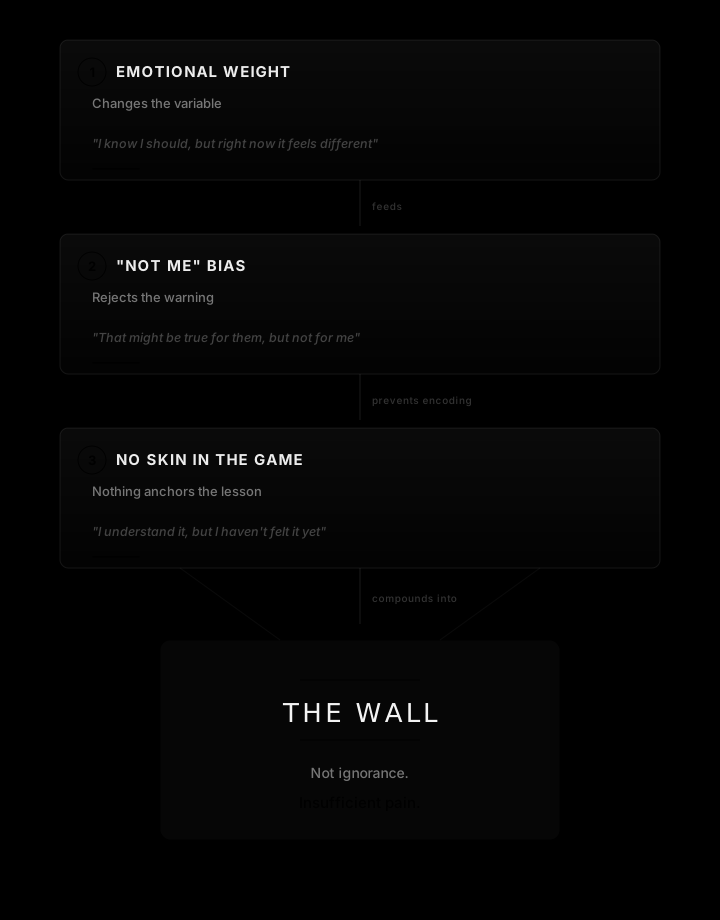
The emotional weight makes you believe you are the exception. The exception bias prevents you from taking the warning seriously. And the absence of personal cost means there is nothing anchoring the lesson deep enough to override the first two. The wall Aristotle noticed, that Seneca tried to rehearse through, that Montaigne wrote an entire essay about — it is not a wall of ignorance. It is a wall of insufficient pain.
The Difference Between Learning It and Learning It Twice
In the closing minutes of Billie Eilish's "TV," the lyrics collapse into a single line, repeated until it dissolves into static: Maybe I'm the problem. Maybe I'm the problem. Maybe I'm the problem.
That line — the willingness to turn the lens inward — is where the unteachable lesson begins to crack. Not to learn. Not yet. But to become learnable. Because the wall described in the previous sections is not a wall of information. It is a wall of framing. And the question "maybe I'm the problem" is the first act of reframing.
Change the model, not the behavior
In 1977, organizational theorist Chris Argyris gave this shift a name: double-loop learning. His analogy was a thermostat. A single-loop thermostat detects that the room is too cold and turns on the heat. It corrects the error. A double-loop thermostat would ask a different question entirely: why am I set to 69°F?
Most of us are stuck in single-loop. We notice the pattern — the toxic relationship, the overwork, the negative self-talk — and we try harder within the same frame. We set better boundaries with the same person. We optimize our calendar instead of questioning why we filled it. We add a morning affirmation instead of asking why we need one. The behavior changes. The governing assumption never does. And so the pattern returns, wearing a different costume, and we are surprised every time.
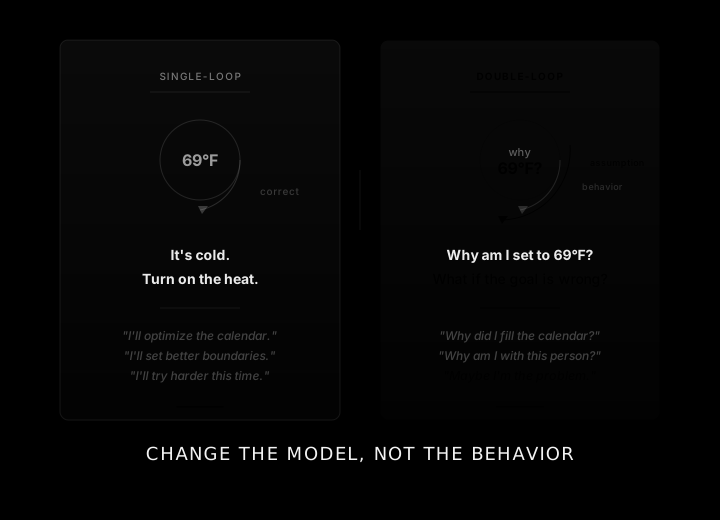
Double-loop learning is harder because it requires questioning the thing you believe is not the problem. It asks: what if the goal is wrong? What if the strategy is working exactly as designed — and the design is the issue? "Maybe I'm the problem" is a double-loop question. It does not adjust the thermostat. It asks why the thermostat exists.
Capture the insight before the rewrite begins
But recognition alone is not enough. The gap between "maybe I'm the problem" and actually updating the mental model requires a mechanism — something that captures the insight before the emotional weight fades and the old frame reasserts itself.
The simplest mechanism is the After Action Review — four questions, asked within twenty-four hours of any significant outcome.
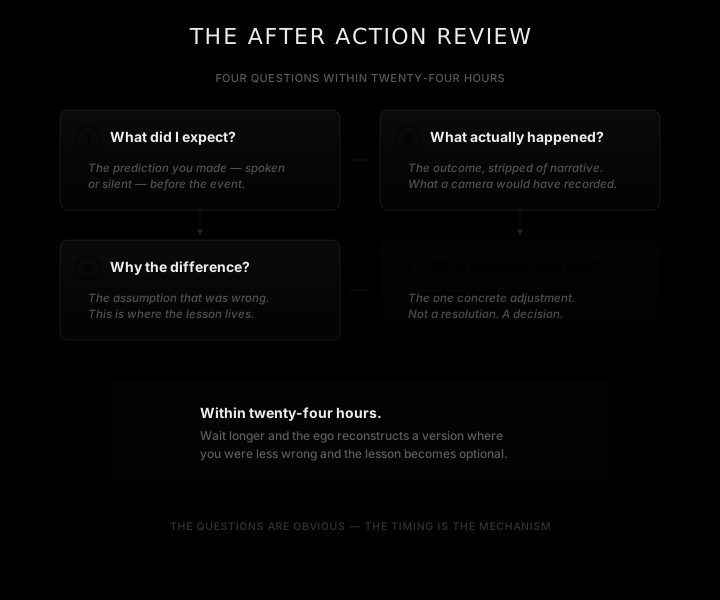
The twenty-four-hour window is not arbitrary. Wait longer and the narrative smooths itself out. The ego reconstructs a version of events where you were less wrong, the situation was more ambiguous, and the lesson becomes optional. The After Action Review works not because the questions are brilliant — they are obvious — but because it forces the confrontation before the rewrite begins.
Version control for your worldview
For the deeper patterns — the ones that recur across years, not days — something more durable is needed.
Keep a private log — digital or physical — with one entry per hard-earned lesson. Each entry has three fields: (1) What I believed before — the assumption that turned out to be wrong. (2) What happened — the specific experience that broke the assumption. (3) What I believe now — the updated model. The point is not journaling. It is version control for your worldview. When you notice yourself falling into a familiar pattern, you check the register. The answer is often already there — written in your own handwriting, from the last time you learned this lesson and forgot.
The Scar Register works because it converts unteachable lessons into self-taught ones. You cannot borrow someone else's scars. But you can stop ignoring your own.
The Permission
If you have read this far and feel exposed — good. That was the point. Not to judge. To make visible what was already running in the background.
There is a version of this essay that ends with a call to action. Break your patterns. Start your Scar Register tonight. Do the After Action Review tomorrow. And you should — all of that works. But before the doing, something quieter needs to happen first.
You need to stop punishing yourself for lessons you had to learn the hard way.
The wall between instruction and experience is not a personal failure. It is a structural feature of being human — not something to fight, but something to work with. Aristotle hit it. Seneca hit it. Montaigne hit it. You were never going to be the exception. Nobody is. The smartest people who ever lived could not skip this curriculum — and they wrote about it, explicitly, so that you would know it was not just you.
The goal was never to avoid the wall. The goal is to stop walking into the same wall twice.
That is the difference between an unteachable lesson and a wasted one. The lesson will cost you something — that is the price of encoding. But the cost only compounds if you refuse to update the model after paying it. One heartbreak teaches you what no advice column ever could. Two heartbreaks teaching the same lesson is not depth — it is avoidance wearing the mask of bad luck.
You are not behind. You are not broken. You are not the only one sitting with a pattern you know you should have broken by now. We all are. Some of us just know we need to work on it.
And as Marianne Williamson wrote — your deepest fear is not that you are inadequate. It is that you are powerful beyond measure. The unteachable lessons are not proof that you are slow. They are proof that you are standing at the edge of something you already understand but have not yet had the courage to act on. Like I am while writing this Thesis.
Learning the hard way is not optional. Doing it twice is.
Frequently asked questions
Why is learning by doing more effective than being told?
Some lessons only transfer through experience: you need to feel the consequence to change behavior. Explanation gives you knowledge; doing turns it into judgment.
Why can't some lessons be taught through explanation?
Certain types of knowledge — what Aristotle called phronesis (practical wisdom) — require lived experience to internalize. The gap between knowing something intellectually and acting on it consistently is bridged by personal stakes, emotional weight, and repeated exposure, not by better explanations.
What is the difference between knowledge and wisdom?
Knowledge is information you can articulate and transfer — facts, frameworks, instructions. Wisdom is the ability to apply the right knowledge in the right context at the right time. It requires judgment shaped by experience, not just understanding shaped by study.
How do you learn lessons that resist being taught?
Through deliberate exposure to situations that demand the lesson, combined with reflection after the experience. Mentorship helps not by explaining what to do, but by creating conditions where you encounter the lesson yourself — and then helping you recognize what happened.